
Wire harness manufacturers are under pressure to move faster, reduce errors, and manage increasingly complex builds without adding more manual work. But disconnected design data, paper-based processes, slow sequencing, and limited shop floor visibility make that difficult to achieve.
The latest smartBuild 6.1.0.M.1 release is built to change that.
With new AI-powered sequencing, guided accessory build steps, and smarter workspace management, smartBuild helps teams turn complex harness data into a faster, more controlled digital workflow.
The impact is measurable:
Reduce wire harness build times by up to 50%. Cut direct labor costs by up to 25%. Reduce design-to-build delays by 95%. Train new technicians in less than half a day.
Reduce manual handling by up to 95%. Validate up to 10x faster. Move from design to build in 48 hours.
For manufacturers facing labor shortages, rising production demands, and increasing harness complexity, these numbers represent more than efficiency gains. They represent a smarter way to build.
One Platform. Digital Workflow. AI Powered.
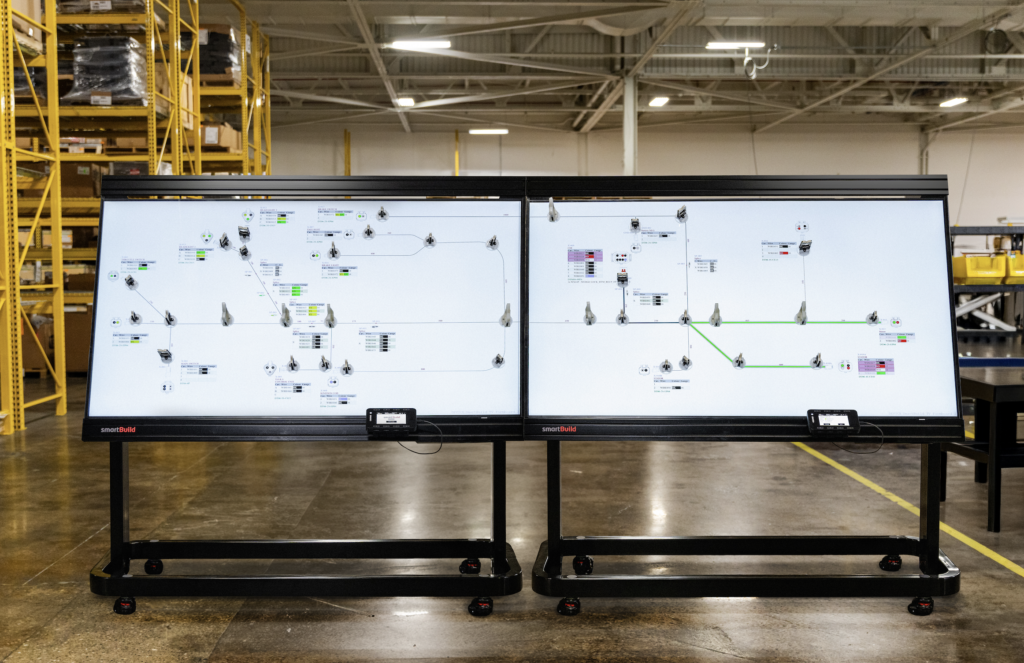
smartBuild gives engineering and manufacturing teams a single digital workflow for turning harness data into clear, guided shop floor execution. Instead of relying on printed instructions, static formboards, manual sequencing, and disconnected testing processes, teams can work from a more accurate, traceable, and intelligent production environment.
The newest release builds on that foundation with three major updates designed to remove bottlenecks and improve confidence across the build process.
Non-wiring assembly steps are now easier to define, follow, and complete.
With the new Accessory Build Guidance capabilities, smartBuild supports accessories such as cable ties, braids, and connector labels directly within the build sequence. Fully animated visual guidance helps operators identify the correct item at the correct stage of the build, reducing guesswork and helping prevent missed or incorrect components.
The release also includes formboard visualization, zoom and pan capabilities, and the ability to add accessories as groups or individual steps. This gives engineers more control over how accessory steps are sequenced and gives operators clearer instructions on the shop floor.
Creating build sequences no longer needs to be a fully manual process.
The new AI Build allows teams to create, adjust, and validate AI-suggested assembly sequences before they go live. Engineers can enter a request, review strategy analysis, processing order, build logic, and operator feedback, then confirm the sequence before it is created.
This gives teams the speed of AI with the control of human review. Instead of starting from scratch, engineering teams can use AI to support more logical build paths, reduce repetitive work, and accelerate the move from design data to production-ready instructions.
As production scales, workspace organization becomes critical.
The latest release introduces enhanced Archive Management, allowing teams to archive and restore Projects, Sites, Build Sequences, and Metrics. Active and archived filters help teams keep current workspaces clean while maintaining access to historical data when needed.
For teams managing multiple builds, sites, and production workflows, this makes smartBuild easier to navigate and more efficient to maintain.
The wire harness industry is moving too quickly for disconnected, manual workflows to keep up. Manufacturers need faster build preparation, better operator guidance, stronger traceability, and tools that help teams do more with less.
smartBuild 6.1.0.M.1 delivers practical, AI-powered improvements that support real production challenges. From guided accessories to AI-assisted sequencing and cleaner workspace management, this release helps teams build faster, reduce errors, and bring more confidence to every harness.
Ready to see the latest smartBuild release in action? Book a demo and discover how Cadonix can help your team move from design to build faster.
Together, Arcadia and smartBuild help close the gap between engineering intent and shop floor execution.
The most forward-thinking manufacturers are now going further. AI-generated build sequences, created from natural language prompts, mean that optimising assembly order no longer requires hours of manual configuration. A manufacturing engineer can describe their preferences in plain language. “Pre-assemble any connector with more than ten wires.” “Route from left to right.” and the AI builds the full assembly sequence automatically. This is not a distant future. It is what teams running modern harness manufacturing solutions are doing today.
Customer drawings, supplier documents, legacy PDFs, and spreadsheets often contain important design information, but they are not easy to use in a digital workflow. Engineers may need to manually recreate BOMs, cavity tables, wiring data, and other details before the design can move forward.
Cadonix Import AI helps solve this by transforming static PDFs into structured harness data automatically, accurately, and in minutes. It uses domain-aware intelligence to identify harness information and includes guided human validation so teams can review and confirm outputs before the data enters the workflow.
Once validated, the design can open natively in Arcadia, ready for routing, quoting, and build preparation.
One of the most persistent challenges in harness manufacturing is the skills gap. New employees usually take weeks/months to learn complex harness assembly. With animated, guided instructions, they can be productive same-day Animated build instructions change that dynamic entirely. When every step is visually guided, colour-coded, and broken down to exactly the right level of detail, new technicians can become productive in under half a day on builds that would previously have been reserved for veterans. That is not just an efficiency gain. It is a fundamental shift in how manufacturers can staff and scale their operations.
Cadonix Harness AI acts as an AI-powered design assistant built directly into Arcadia. It reviews designs against company standards, customer requirements, and manufacturing rules when analysis is triggered.
Harness AI can support customer-specific standards validation, recurring defect detection, electrical design verification, design-specific analysis, and custom report generation. This helps teams catch issues before release, reduce repeat mistakes, and produce documentation aligned with internal and customer requirements.
For engineering teams, this means fewer late-stage surprises. For manufacturing teams, it means cleaner data entering production.
Beyond the shop floor, there is another conversation happening. Operations leaders and manufacturing managers are increasingly being asked to do more with less, and to prove it with data.
Real-time efficiency metrics, first-pass yield tracking, per-station productivity data, and full traceability across every wire, connector, and splice are no longer luxuries. They are the baseline for any manufacturer that wants to compete on quality and delivery. The manufacturers pulling ahead are not guessing at their bottlenecks. They are seeing them in real time and acting before they compound.
The platform also supports continuity and isolation testing at the build station, allowing teams to validate every connection in real time and detect errors earlier in the process.
With AI build sequencing, smartBuild can automatically generate and optimize build sequences based on manufacturing preferences, helping teams reduce manual preparation work and accelerate production.
Companies using connected digital harness workflows are pulling ahead of companies still using paper setups. They are building faster, training quicker, catching errors earlier, and generating the kind of traceability data that opens doors with customers in regulated industries.
smartBuild from Re:Build Cadonix is the manufacturing solution built for exactly this transition. From AI-generated build sequences and animated assembly guidance to at-station continuity testing and cloud-based reporting, it is designed to take manufacturers from where they are to where they need to be, without disrupting what is already working.
The gap between these two groups of manufacturers is growing. The right time to close it was yesterday. The next best time is now.
Modern harness complexity cannot be solved with disconnected tools and manual processes.
Teams need wiring harness design software that supports the full journey from schematic to production, helping engineering and manufacturing work from the same connected data.
Cadonix Arcadia and Cadonix smartBuild, powered by AI features, help reduce complexity by connecting design, validation, guided build instructions, testing, and traceability in one smarter workflow.
For manufacturers looking to improve accuracy, reduce rework, and accelerate production, a connected design-to-build process is no longer optional. It is essential.
Want to see what smartBuild looks like in a production environment? Get in touch with the Cadonix team. And if you want to go deeper on what smartBuild can do, download our brochure for a full look at the platform.
Whether you’re reducing formboard lead times or transitioning to digital build stations, smartBuild by Re:Build Cadonix removes manual complexity from harness assembly so your teams can build faster, with higher quality, and complete confidence from design through testing.